Photographs by Frank

24 August 2010

Dana’s Vist to Camp

Filed under: "Camp",Amphibians,Odontates — Tags: , , — Frank @ 7:47 AM

My friend (and fellow photographer) Dana Lipp came to camp for a day trip about a week ago.

As we usually do when we get together, we chat about many things, even photography on occasion. We also often find time to make some photographs.

This day we haunted, as is my habit, the lake shore near camp. The lake as been dropping all summer and so by mid-August there was a bit of dry(ish) land all along the shore. Thus Dana did not get the “full effect” but I am sure that he’ll agree he got the essential felling of the experience!

It was very interesting to see Dana’s photographic take on an area where I have spent an extensive amount of time; he saw subjects that I have overlooked for months and made some very nice photographs. Dana posts his photos on Flicker and so I will just link to his “Antrim Camp” set there.

And here are a few of the photos I took that day:

[nggallery id=23]


30 July 2010

Late July’s Crop (of Photographs)

Filed under: "Camp",Odontates — Tags: , , — Frank @ 3:30 PM

The corn is in a Tenney’s farm stand, so it must be late July!

We’re back in Bridgewater — briefly — Katrina spent the past week with us up at camp and need to get to the airport early this morning. Thus, here are a dozen and a half images from the past couple of weeks.

The first two photos — of “damsels in distress” — were taken the same afternoon within about 50 yards of each other. Some days you just get lucky… unless you were one of the odontates!!!

The first two frog photos were taken on the beach just outside of the cabin… I got very wet getting the one of the bullfrog.

Joan spotted the wood frog while we were walking the road up on Patten Hill. I stayed behind to make photographs while Joan wandered ahead. After a bit I wander off in the direction that she had gone but Joan had wandered into the woods and I went past her. When she reemerged she headed back to where the frog had been. She could tell the exact spot even though neither the frog or I were there as there was a large patch of flattened ferns… I can’t imagine how such a small frog flattened so so many ferns!

Anyway, she eventually caught up to me and as we were walking near the top of the hill, I stopped to stalk a dragonfly… I watched it take a couple of hunting forays from a perch as I tried to get near enough for a photo… just as I was getting ready to take a photo it took off on another hunt — nothing unusual there — but instead of going back to it regular perch, it alit right on the top of my lens… with a big old horsefly in its mouth!!! Needless to say I did not get a photograph as it fly off to parts unknown as Joan approached to get a look!

The reminder of the photos were taken down in the beaver swamp near the public beach. Upon my arrival, I stepped onto the bog mat at the edge and scared a big bullfrog into the water. After sometime, I was crouched down stalking odonates when I noticed the frog reappear. I got  a couple of photographs and then I spooked him again. Off he took with a great leap and I could not find him among the grass and reeds. I went back to the odontates and some minutes later I spotted the frog again… just his eye!

Along a stretch of bog shore not more that 20 feet long, I got some nice shots of a number of species that do not hang out on the more open lake shore. Different environments (ecological niches) = different species… basic biology. Note to self:  stray away from the lake shore more often!

Here are the images:

[nggallery id=22]


13 July 2010

Late June and Early July at Camp

Filed under: "Camp",Odontates — Tags: , , , — Frank @ 4:34 PM

Well, we have spent the last three weeks or so (minus two days, including today) in NH.

Our days have been spent doing small projects intended to keep the place standing, some reading and thinking, some boating (sailing, rowing, canoeing and kayaking) and maybe a bit of napping, too!

In addition, I still have managed to find time to roam the lake shore in search of odontates. As many of you know, I do this by wading in the shallows… never more than five or ten feet from shore and  in water that is rarely more than knee-deep.

Some photos are taken standing up as odontates like to perch on the shrubs along the shore. Others are taken kneeling, squatting or sitting  — laying, too, but not recently — in the water.

I have, on many occasions, put the lens of the camera six or eight inches off of the water. Whatever it takes to get the “eye-to-eye” view that makes for strong photographs of other creatures!

The first gallery has photographs from before 1 July. I did not have time to upload them when we were last home.  You will note that the images are mainly of damselflies, especially variable dancers… there did not seem to be much variety this early in the season. There were a few dragonflies of the type that rarely perch; rather they are constantly on the move hunting and defending their territory. They are very hard to take photos of!

[nggallery id=20]

The second gallery contains photos taken between 1 July and 12 July. Now you will see a bit more variety in the odontates around the lake.

[nggallery id=21]

In addition, we have had  “interesting” sun sets on a few occasions and I have taken the opportunity to make some ‘cloudscapes”.

[singlepic id=127 w=300]

[singlepic id=134 w=300]

[singlepic id=141 w=300]

What do you think?

Comments/critiques on any or all of the images are greatly appreciated… thanks!


24 June 2010

Swamp Spreadwings & Blue Dashers

Filed under: Carver's Pond,Odontates — Tags: , — Frank @ 12:00 PM

Yesterday, I made another quick trip to Carver’s Pond just to see what was around; I headed out around four. As six o’clock approached the sky darkened considerably and there were a few sprinkles. After that the number of odontates diminished significantly and I called it a day.

There were a number of mated pairs of swamp spreadwings ovipositing. This species oviposits  in tandem, with the male holding on to the female by the back of the neck as she deposits eggs. The female has a knife-like organ at the end of her abdomen which she uses to slice open the stems of plants above the water line. The eggs are deposited  into the openings she cuts.

  [nggallery id=19]

There were also a number of blue dashers around, each male defending a territory from a convienent perch. When an interloper arrives the perched male takes off and a short (and non-violent) aerial dog fight takes place.

  [singlepic id=117 w=300]


22 June 2010

Skunked by the WHS Osprey

Filed under: Birds,Southeastern MA — Tags: — Frank @ 12:00 PM

At the edge of the parking lot at the Wareham High School (where Joan works) there is a nesting pole and osprey nest.

Joan and I spent a couple of Saturday evenings down there watching the birds early in the season (around the first of May) and I got some nice shots including this one from our first visit:

[singlepic id=109 w=300]

 I also posted a few more shots, and an interesting story, from our second visit on the HDP blog.

We decided to go back again last Saturday (19 June 2010) evening as Joan had seen an osprey in the area earlier in the week.

We headed down relatively early (given that sunset was not until 8:25), had clam plates at Kool Kone on Route 6 and were in place at the WHS parking lot finishing up our ice cream by 6:15. There was a Wareham Gatemen (Cape Cod League) game beginning on the WHS diamond at 6:30 so we were entertained by the PA announcements as we waited for osprey.

And wait we did… we were there for about an hour and saw no sign of osprey… neither adults nor chicks in the nest. Either the chicks have already fledged (but I think it is too early for that) or the pair we saw nesting back in May did not produce chicks this year.

Since there was not a lot of bird action, we were able to get some “technical” shots.

Here is how one goes about getting a good angle on a nest at the top of a tall pole:

[singlepic id=106 w=300] (Photo by Joan.)

And here is the view that the camera was pointed at:

[singlepic id=107 w=300]

As you can see I could have actually gotten the truck much closer to the pole (and nest) but setting up some distance back (and using the long lens) allows for a more desirable “looking across” view rather than a “looking up” view

After about an hour of watching and waiting we made the decision to go look for access to another nest we had seen from Route 25 and heard about from one of the locals,  instead of going to the baseball game. Thus we had a nice drive around many of the back roads of Wareham and Buzzards Bay and no success in locating the second site before we headed home as the sun set.

Skunked, on all fronts, by the osprey of Wareham… such is the life of a wildlife photographer!

Update: Adding insult to injury… when Joan arrived at work early Monday morning, there were two adult osprey sitting on the nest!


16 June 2010

Carver’s Pond… Yet Again.

Filed under: Carver's Pond,Odontates — Tags: , — Frank @ 12:00 PM

Last Saturday (12 June 2010) dawned gray and the forecast was for showers starting in the early afternoon. Cool (high 60’s)  and cloudy is not a good combination for hunting odontates, but I figured why not! Thus, after a leisurely breakfast, I headed back to Carver’s Pond.

It is nearby so I could, by avoiding a longer drive, maximize my “field time”  before it started raining. In addition, I had not been there in over a week (that pesky day job) and it was time to see what was new!

I spent an enjoyable few  hours at the pond and was just heading back to the truck a bit after noon, when the rain got serious.

There were two real finds among the more common sights. The first was a male emerald  swamp spreadwing (Lestes dryas viglax).  [Identification updated on 23 June 2010… emerald and swamp spreadwings are very similar with swamp spreadwings being common and emeralds being “uncommon” according to “A Field Guide to the Dragonflies and Damselflies of Massachusetts” by Nikula, et al. (order here) which is my primary source for identiflying odontates.]

[singlepic id=88 w=300]

Spreadwings are a small group of damselflies that generally perch obliquely on reeds and other stems emerging from the water. Additionally, when at rest, they hold their wings partially open unlike most damselflies who keep their wings tightly together when at rest.

The second find was a teneral female common pondhawk (Erythemis simplicicollis).

Odontates lay their eggs in water where they develop into larva. The larva overwinter (at least one year) in the water before emerging as adults. As the water temperature rises in the spring the larva emerge from the water and the adult emerges.

Each species has a characteristic temperature at which they emerge. The earliest odonates typically emerge in mid-May here in New England while the latest emerging species probably make their appearance around the end of June.

The newly emerged adult is characterized as “teneral”. In this state its body is very soft and its wings are not yet able to support flight. Teneral adults are usually found clinging to vegetation near the water and are very vulnerable to predation both by birds and by fish. As soon as they are able, teneral adults make a very weak initial flight to a more secure location to finish “drying out”.

[nggallery id=15]

I noticed this individual after she had fully emerged. She was clinging to the grass stems and still had her rear end in the water and her wings were still folded back. (This is the only time you will see a dragonfly which wings held together.) Over the course of the five or ten minutes I watched her, she crawled up the stems as far as she could go and her wings became outstretched. You can see the very shiny wings typically of a newly emerged dragonfly; they only stay that way for a day or two. I decided that I had stressed her enough and moved away before she was ready to fly.

Here are the rest of the mornings photos:

[nggallery id=14]


14 June 2010

The Dragonfly Rig

Filed under: Odontates,Other Insects — Tags: — Frank @ 12:00 PM

Warning… photo geek talk below!!!

A number of people have asked me about the tools I use to shoot odontates (i.e. dragonflies and damselflies). So here is the answer!

The  basic “problem” is that these critters are relatively small and somewhat wary. Thus one needs significant magnification and decent working distance.

In the past I have used the Sigma 50-500 mm zoom to make photos of dragonflies… this lens has a short (for a long telephoto) close focus distance which allows for modest magnification so some cropping is needed to make a “frame-filling” image. This lens is also large and heavy and therefore it needs a tripod (or monopod) which limits mobility.

In looking for a better solution, I switched to a Nikon 70-300 VR mm lens with a 36 mm extension tube. This combination often allows one to make frame-filling images of dragonflies and it is much lighter, allowing one to hand hold the rig (the VR helps here too).

I have been using this rig for about a year now and have made many nice photographs with it. But… isn’t there always a “but”… this spring I decided to go further!

Shooting at high magnification leads to a small depth-of-field. I’m not going to try and explain the physics of the situation… it is just a fact of life… the higher the magnification the small the depth of field.

The way to get more depth of field is to decrease the aperture (i.e. increase the f number).  Of course, this leads to less light reaching the sensor and that needs to be compensated for with a longer exposure or a higher ISO both of which cause their own problems… life is tough!

Adding some extra light (from a flash) into the picture (pun intended… go ahead and groan!) would help to mitigate these problems. However, the quality of the light is important … direct flash coming from directly over the lens is, to put it simply, ugly!  The flash needs to be off camera and it will need some diffusion.

Adding off camera flash to the mix introduces a problem that comes with having only two hands… one of which is usually in use to trigger the shutter and the other of which is usually in use steadying and operating  the long lens! There is no hand “left over” to hold a flash nearby. Thus one needs to tie the camera and the flash together.

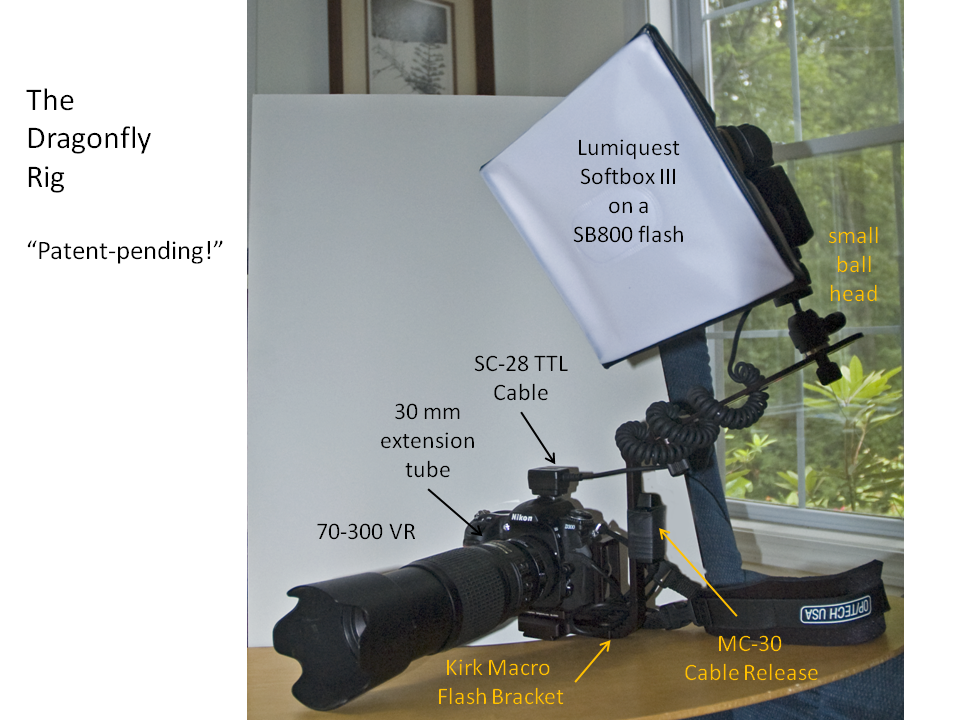
So here it is (click for a larger view)… everything all in one unit:
This unit is, to put it simply, large and unbalanced! As most people do, I usually use my left hand to steady a long lens and my right hand to work the camera controls and trigger the shutter. This was impossible to do with this rig… the flash hanging way out on the left really unbalances things and I could not hold it steady.

The solution… use the flash bracket as a handle. By gaffer taping my cable release to the flash bracket, I can now trigger the shutter with my left hand (which is also supporting the heavy side of the rig) and use my right to operate the lens. With this system, I’m going to have to stick auto exposure since the other camera controls haven’t moved. This is not a big deal for me as I usually use matrix metering in aperture priority mode anyway.

The total unit is still large, heavy and unbalanced enough to cause pain in my wrists and elbows on my first few outings.  The torque it puts on ones joints while in use is significant. I have diminished this problem in two ways… by remembering to let the rig hang from the neck strap between shots and by supporting the rig with a monopod when possible. Of course the monopod limits my mobility a bit and needs to be removed to get a really low perspective. But life is full of compromises… isn’t it?

One last comment… the magnification provided by this rig is just not quite there yet when it comes to damselflies, so I am still resorting to cropping in order to “fill the frame” with these critters. The solution, of course, is more magnification (attained by adding another extension tube). I have my doubts as to the ability to get a crisp image at even higher magnifications without resorting to a tripod, but I will be experimenting over the summer and time will tell.

12 June 2010

Ants Herding Aphids

Filed under: Other Insects,The Yard,Wildlife — Tags: , , — Frank @ 9:11 AM

Yesterday after work Joan went out to inspect her vast flower beds. At one point she stuck her head back in the door to say “There are ants herding aphids out here.”

I have learned over the years that when your wife spotter announces a find I am required go get the camera and investigate.

For those of you who have not heard about or seen ants herding aphids, it is an example of biological mutualism. You can read more about it here.

As you know, ants are very small (these were about one quarter of an inch long) and (most commonly) black. This makes for a difficult photographic subject. Thus,  I had some experimenting to do.

To get high magnifications, I used my extension tubes… this was the first time I had a need for all three at once.  The camera was mounted on the tripod… no hand holding at this magnification.

Light was provided by an off camera flash diffused with a soft-box. This was lying on the ground off to one side or hand held off to the side more-or-less at the level of the subject.

This  photo was taken using my 70-300 mm lens with three extension tubes (36 + 20 + 12 = 68 mm):

[singlepic id=85 w=300 h= mode= float=]

For this photo, I switched to the 90 mm macro lens and ended up using just the two larger extension tubes… all three tubes gave too much magnification:

[singlepic id=86 w=300 h= mode= float=]


3 June 2010

Memorial Day Weekend

Filed under: "Camp",Amphibians,Odontates — Tags: , — Frank @ 12:00 PM

For us, like many,  Memorial Day weekend means the beginning of summer. As is our habit, we headed north to “open up” camp for the season.

Opening up camp is not a big deal since there are no utilities involved… we evicted the mice who had taken up residence over the winter, picked up a few things, swept the place up and were ready to go! In addition to these chores on Saturday, we spent Sunday afternoon finishing up last years siding project. However, I was also able to find several good chunks of time for photography.

Although I never strayed more than 100 yards from camp, I was never lacking in subjects. Dragonflies were present in abundance, both numerically  and in the variety of species. I only saw two damselflies the entire weekend… too early in the season I guess.

One of the damselflies I saw was an ebony jewelwing which cruised by quickly along the lake shore. This was very odd as the jewelwings are most usually associated with the flowing water of small streams and rivers. I have never observed them on the lake before. It was probably a fluke but we’ll see as the summer progresses.

As is often the case, I noticed many other insects as I stalked dragonflies and a couple of photos of these are included in the set below.

There were a couple of permanent residents who were not happy with our arrival. We had noticed that the beaver house in the corner of the cove looked to be in pretty good shape and about dusk on Saturday we noticed two beavers out and about. One of them was clearly not pleased with our presence! He (or maybe she) cruised by the cabin a dozen time or more slapping its tail loudly on each pass. Of course, I wanted a photo of the action and ended up having Joan wave a bright yellow life jacket when the beaver was in a good spot photographically just to get a tail slap. The light was very low but here is an OK image of a beaver tail and big splash.

[singlepic id=66 w=300 h= mode= float=]

The permanent residents of the amphibious kind were also present… we saw both a green frog and a couple of northern leopard frogs around the rocks on the beach.

At mid-afternoon on Monday we had two visitor of the avian persuasion… a loon and a great blue heron. The loon fished quite contentedly and quite nearby for sometime; probably kept in the cove by the boat activity out on the main part of the lake. The heron fished briefly on both sides of the cove before taking off again. The harsh mid-day light did not make for good photographs of either one.

Here are the weekend’s photographs…

[nggallery id=11]

I’m still working on identifying most of the dragonflies… this is not one of my strong points!


1 June 2010

More Odontates from Carver’s Pond

Filed under: Carver's Pond,Odontates,Southeastern MA — Tags: , — Frank @ 11:03 AM

Carver’s Pond is an old mill pond in Bridgewater, MA. It is about two miles from our house and just up the street from the College. I walk there from work at lunch time many days. It is a place we go when we have time only for a very short jaunt… sometimes with the kayaks or canoe or sometimes just for a walk.

The pond is home to much wildlife… turtles,  fish, birds, small mammals and, of course, odontates. I spent a few hours hunting dragonflies and damselflies there again last Thursday.

It is good to go back to the same place often… just to see what has changed.

In the case of odontates, the “signal” for emergence from the larval form to the adult is mainly water temperature. Each species has a specific temperature at which it emerges.  This time of year, when the water is warming rapidly, new species seem to “pop up” almost daily. Thus, multiple trips, even in quick succession are often rewarded with new species to see and photograph.

Here are some of the day’s photographs:

[nggallery id=10]


« Newer PostsOlder Posts »

Powered by WordPress